

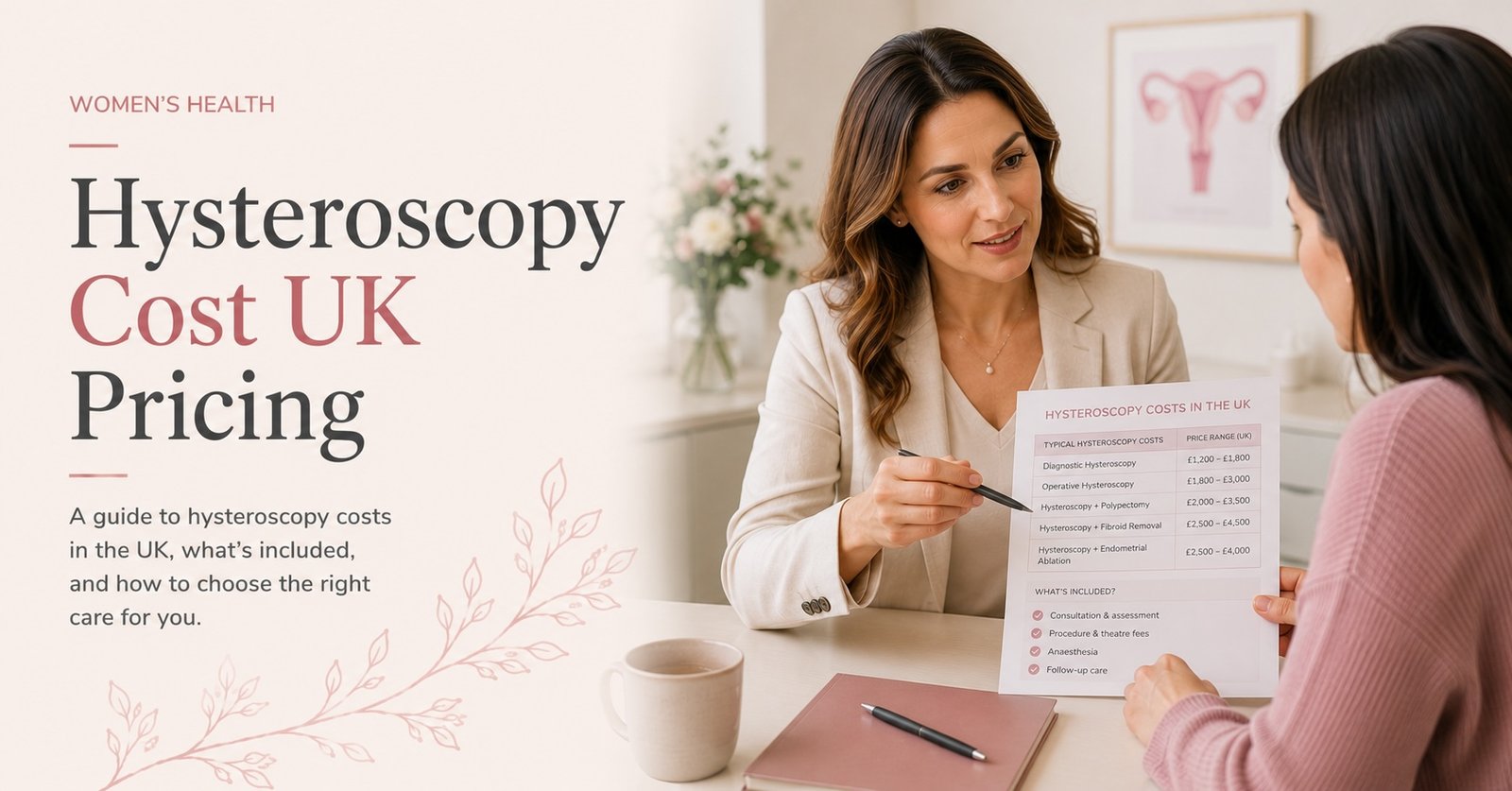
Private hysteroscopy cost in the UK ranges from approximately £1,500 for a diagnostic outpatient hysteroscopy to £4,500 or more for an operative hysteroscopy under general anaesthetic with polyp or fibroid removal. NHS hysteroscopy is free at the point of use but waiting times currently range from 6 weeks for urgent cases to 12 months or more for routine investigation in some regions. Private medical insurance covers hysteroscopy in most cases when symptoms meet defined criteria.
If you have been told you may need a hysteroscopy, the two questions on most patients’ minds are:
- How much will it cost privately?
- How long will I wait on the NHS?
This guide gives you straight answers on both, explains exactly what is included in private pricing and helps you decide whether private is worth it for your situation.
What is a hysteroscopy?
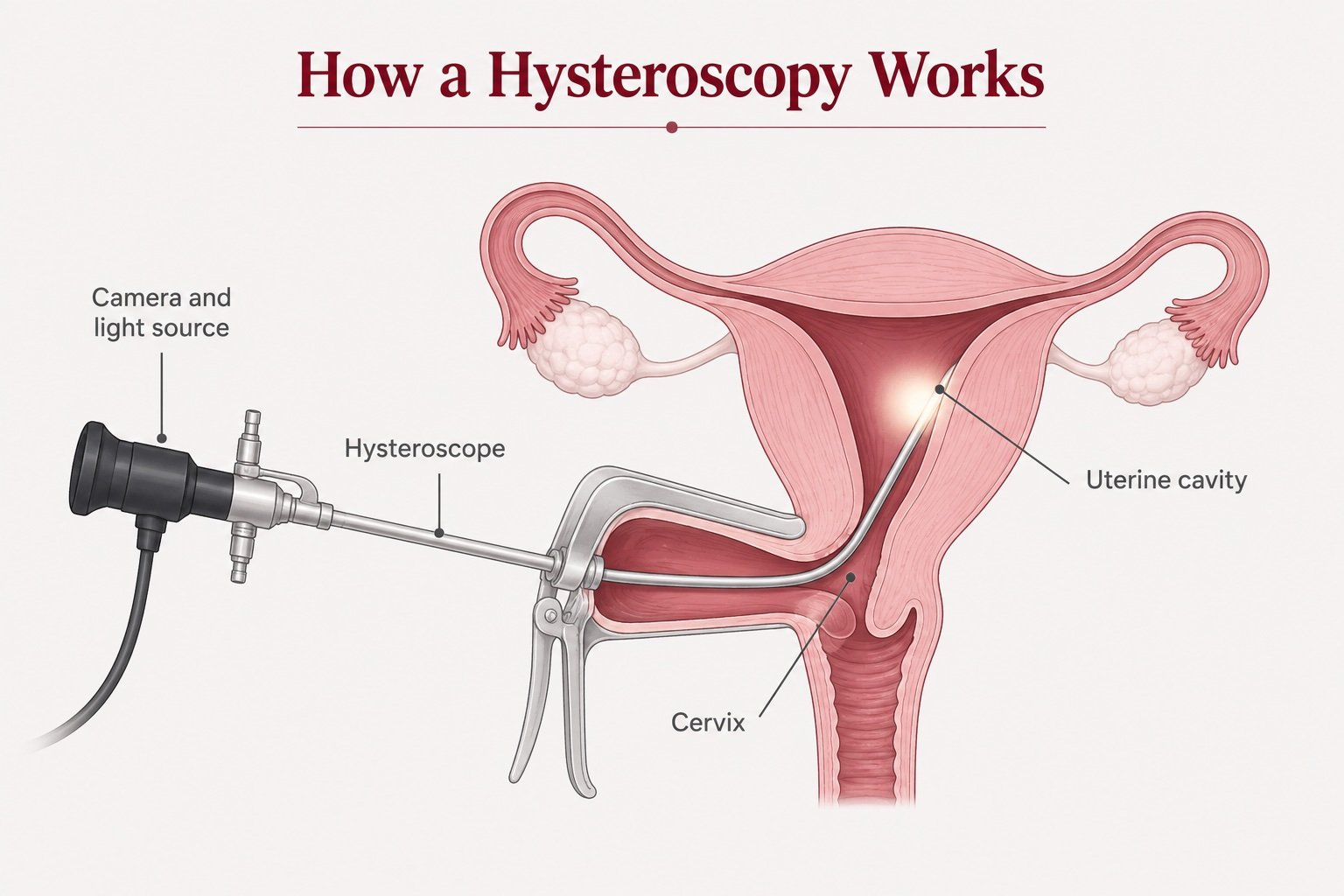
A hysteroscopy is a procedure that allows a gynaecologist to look directly inside the uterus using a thin, lighted telescope called a hysteroscope.
It is used to investigate symptoms such as heavy or abnormal bleeding, post-menopausal bleeding, recurrent miscarriage, infertility and to remove polyps, small fibroids or take biopsies.
There are two broad types:
- Diagnostic hysteroscopy – looks inside the uterus to identify a problem. Often done as an outpatient procedure under local anaesthetic or no anaesthetic.
- Operative hysteroscopy – removes polyps, small fibroids or scar tissue or takes targeted biopsies. Usually done under general anaesthetic but increasingly performed as an outpatient.
How much does a private hysteroscopy cost in the UK?
Prices vary depending on the type of anaesthetic, whether the procedure is diagnostic or operative, whether biopsies are taken, the hospital or clinic chosen and the consultant’s grade.
Here are some typical price ranges (UK):
| Procedure type | Setting | Typical cost range |
|---|---|---|
| Outpatient diagnostic hysteroscopy (no anaesthetic or local) | Clinic outpatient room | £1,200 to £2,200 |
| Outpatient operative hysteroscopy (e.g. small polyp removal under local anaesthetic) | Clinic outpatient room | £1,800 to £3,000 |
| Diagnostic hysteroscopy under sedation | Day-case unit | £2,500 to £3,800 |
| Operative hysteroscopy under general anaesthetic (polyp or fibroid removal) | Day-case theatre | £3,500 to £5,500 |
| Hysteroscopy with endometrial ablation | Day-case theatre | £4,500 to £7,500 |
What is included in the private hysteroscopy cost?
A reputable private hysteroscopy package should include all of the following (always check before booking):
- Initial consultant consultation (or a separate cost specified)
- The hysteroscopy procedure itself
- Hospital or clinic facility fee
- Anaesthetic fee if applicable
- Pathology and histology fees for any biopsies taken
- Written report
- Follow-up consultation to discuss findings
What is sometimes not included:
- Pre-procedure ultrasound scans (often a separate £250 to £400)
- MRI imaging if needed for further assessment
- Treatment of any unexpected findings
- Ongoing treatment for a condition diagnosed
How long is the NHS hysteroscopy waiting list?
Current typical wait times across the UK in 2026 are estimated as follows (subject to change):
- Urgent (suspected cancer): 2 to 6 weeks
- Routine investigation of heavy bleeding or post-menopausal bleeding: 8 to 26 weeks in many areas
- Routine fertility-related hysteroscopy: 16 to 52 weeks in some regions
- Operative hysteroscopy for polyp or small fibroid removal: 6 to 18 months in many areas
If you are worried about your symptoms or simply want a faster diagnosis, private hysteroscopy can be arranged within days to a few weeks at most private clinics.
When is a hysteroscopy worth doing privately?
Private hysteroscopy may be worth the cost if any of these apply:
- You have heavy or abnormal bleeding affecting your daily life and do not want to wait months
- You have post-menopausal bleeding (always investigate promptly)
- You are trying to conceive and want a faster diagnostic pathway
- You have private medical insurance that covers the procedure
- You have been on an NHS waiting list for several months without a date
- You want to choose your consultant and where the procedure is done
Does private medical insurance cover hysteroscopy?
Most major UK private medical insurers cover hysteroscopy when symptoms meet their criteria.
Common authorising symptoms include:
- Heavy menstrual bleeding affecting quality of life
- Bleeding between periods
- Post-menopausal bleeding (almost always covered)
- Suspected polyp or small fibroid identified on ultrasound
- Recurrent miscarriage
UK insurers used by Ovara Health patients include Bupa, AXA Health, Aviva, Vitality, WPA and CIGNA.
Always confirm with your insurer before booking and check whether your policy requires GP referral.
Most patients that come to Ovara are seen for consultation within days and the procedure can usually be scheduled within a further 1 to 2 weeks.
What is the difference between outpatient and general anaesthetic hysteroscopy?
Outpatient hysteroscopy
- Performed in a clinic room without general anaesthetic
- Local anaesthetic injected into the cervix
- No fasting required
- You can usually drive home afterwards
- Recovery: most women return to normal activities the same day or next
- Lower cost
- Best suited to diagnostic hysteroscopy and small polyp removal
- Some discomfort or cramping is common but most patients tolerate it well
Hysteroscopy under general anaesthetic
- Performed in an operating theatre
- Requires fasting beforehand
- Cannot drive on the day
- Recovery: usually home the same day, back to normal within 1 to 3 days
- Higher cost
- Necessary for larger fibroids, complex cases or women who cannot tolerate the outpatient procedure
NHS vs private hysteroscopy: a comparison
| Feature | NHS | Private |
|---|---|---|
| Cost | Free | £1,500 to £5,500 |
| Wait for consultation | Often 6 to 12+ weeks | 1 to 2 weeks |
| Wait for procedure | Often 3 to 12+ months | 1 to 3 weeks |
| Choice of consultant | Limited | Full choice |
| Single room as day case | Variable | Typical |
| Follow-up timing | Variable | Usually arranged at booking |
What does recovery look like?
After outpatient hysteroscopy
- Mild cramping for a few hours, easily managed with paracetamol
- Light spotting for 1 to 5 days
- Return to work the same day or next
- Avoid tampons, sex and swimming for 5 to 7 days if a biopsy was taken
After hysteroscopy under general anaesthetic
- Drowsiness for the rest of the day
- Cramping for 24 to 48 hours
- Light bleeding for up to 2 weeks
- Return to work in 1 to 3 days
- Avoid tampons, sex and swimming for 7 to 10 days
Contact the clinic if you experience heavy bleeding, fever, severe pain or unusual discharge.
Sources and further reading
- NHS – Hysteroscopy
- Royal College of Obstetricians and Gynaecologists (RCOG) – Best practice in outpatient hysteroscopy
- British Society for Gynaecological Endoscopy (BSGE) – Gynaecological endoscopy guidance
- NHS England – referral to treatment standards
Our consultant gynaecologists perform diagnostic and operative hysteroscopy at our Chelsea clinic, with outpatient (local anaesthetic) and general anaesthetic options. Most patients are seen for an initial consultation within days, with the procedure typically scheduled within a further two weeks. New consultation £300, combined consultation and scan £475.
Major private medical insurers accepted – please contact us to confirm your provider.
Frequently Asked Questions
How much does a private hysteroscopy cost in the UK?
From approximately £1,500 for an outpatient diagnostic procedure to £5,500 or more for an operative hysteroscopy under general anaesthetic.
Is hysteroscopy covered by private medical insurance?
Yes, most major UK insurers cover hysteroscopy when symptoms meet their criteria. Always confirm with your insurer before proceeding.
How long is the NHS waiting list for a hysteroscopy?
From 2 to 6 weeks for urgent cases to 6 to 18 months for routine investigation in some regions. These timeframes are subject to change.
Can I have a hysteroscopy without general anaesthetic?
Yes. Most diagnostic hysteroscopies and many small operative hysteroscopies can be performed with local anaesthetic or no anaesthetic.
How quickly can I get a private hysteroscopy?
At Ovara Health and most private clinics in London, you can be seen for consultation within 1 to 2 weeks and have the procedure within a further 1 to 2 weeks.
Is a hysteroscopy painful?
Most women experience mild to moderate cramping during outpatient hysteroscopy, similar to period pain, lasting only a few minutes. General anaesthetic hysteroscopies are pain-free during the procedure.
What is the difference between a hysteroscopy and a colposcopy?
A hysteroscopy looks inside the uterus through the cervix. A colposcopy looks at the cervix itself. They examine different parts of the reproductive tract.
How long does a hysteroscopy take?
A diagnostic hysteroscopy typically takes 5 to 15 minutes. An operative hysteroscopy with polyp or small fibroid removal usually takes 15 to 45 minutes.
Can I drive home after a private hysteroscopy?
After an outpatient hysteroscopy with local anaesthetic only, usually yes. After sedation or general anaesthetic, you cannot drive for 24 hours.
Do I need a GP referral for a private hysteroscopy?
At most private clinics, no. Some insurers require a GP referral letter for cover, so check with your insurer first.
Can a hysteroscopy detect cancer?
A hysteroscopy can identify abnormal areas inside the uterus and biopsies can be taken to test for cancer or pre-cancerous changes. It is one of the most reliable ways to investigate post-menopausal bleeding.
Does a private hysteroscopy include the consultation?
Most reputable private packages include the consultant consultation, procedure, pathology and follow-up. Always confirm what is included before booking.
By Kerry Archer
Medically reviewed by Mr Amer Raza, MBBS MRCOG, GMC 5205372 – 7 May 2026
Book a Private Hysteroscopy in London
Our specialist private consultants perform hysteroscopy procedures at our Chelsea clinic. The majority of patients are seen for an initial consultation within days with the procedure typically scheduled within a further two weeks. Most major private insurance policies are accepted and no GP referral is needed.
