

Fibroid danger is determined more by symptoms and location than size alone. As a general guide: fibroids under 5cm are usually monitored. Fibroids between 5 and 10cm often need active management. Fibroids over 10cm or those causing severe bleeding, pain, fertility issues or pressure on other organs typically require treatment. A 4cm fibroid in a difficult location can cause more problems than a 10cm fibroid in a safer position.
Many women are told during a routine ultrasound that they have a fibroid, only to be left wondering whether the size they were given is something to worry about. The size of a fibroid does matter but it is rarely the only factor.
A small fibroid in the wrong place can cause severe symptoms, while a much larger one in a different position may go unnoticed for years.
What is a fibroid and why does size matter?
Fibroids, also called uterine fibroids or leiomyomas, are non-cancerous growths that develop in or on the muscular wall of the uterus. They are extremely common, with estimates suggesting that up to 70-80% of women will develop at least one fibroid by the age of 50, although many will never have symptoms.
Why size is one factor among several
Size matters because larger fibroids are more likely to cause symptoms such as heavy bleeding, pelvic pressure, urinary frequency and pain. However, size is not the whole story and other factors that matter just as much are:
- Location in the uterus (submucosal fibroids inside the cavity cause heavy bleeding even when small, while subserosal fibroids on the outside can grow large with few symptoms)
- Number of fibroids (multiple smaller fibroids can cause as many problems as one large one)
- Rate of growth (a fibroid that grows quickly may need investigation even if currently small)
A 3cm submucosal fibroid sitting inside the uterine cavity can cause flooding periods and infertility. A 9cm subserosal fibroid on the outer wall may only be discovered during an unrelated scan – the size on its own does not tell us how dangerous a fibroid is.
How are fibroids measured?
Fibroids are measured in centimetres or millimetres using transvaginal or abdominal ultrasound, or sometimes MRI. The measurement reflects the diameter of the fibroid at its widest point.
| Size | Common comparison | Typical clinical approach |
|---|---|---|
| Under 1cm | Pea or smaller | Often incidental finding. Usually monitored only. |
| 1 to 3cm | Small grape to walnut | Monitored unless symptomatic. |
| 3 to 5cm | Walnut to plum | Monitored with annual scans if asymptomatic. |
| 5 to 7cm | Plum to small orange | Active management usually recommended. |
| 7 to 10cm | Orange to grapefruit | Treatment typically advised if symptomatic. |
| Over 10cm | Grapefruit and larger | Treatment almost always recommended. |
These size bands are guidelines, not strict rules. A 4cm submucosal fibroid causing fertility problems will be treated more urgently than a 12cm subserosal one in a woman who has completed her family and has no symptoms.
Which size of fibroid is dangerous?
A fibroid becomes clinically dangerous when it causes any of the following, regardless of its measurement:
- Heavy menstrual bleeding leading to iron deficiency or anaemia
- Severe pelvic pain that is not controlled by standard pain relief
- Pressure on the bladder or bowel causing urinary or bowel symptoms
- Fertility problems or recurrent miscarriage
- Rapidly increasing size, particularly after menopause
- Compression of the ureters, which can damage kidney function in rare cases
The size thresholds most commonly cited in clinical practice:
- Above 5cm: active management is usually discussed
- Above 7cm: treatment is more strongly recommended, particularly if there are symptoms
- Above 10cm: treatment is almost always advised
- Above 14cm: considered very large and almost always treated surgically
Can a fibroid be cancerous?
Fibroids themselves are not cancerous. The risk of a fibroid being a leiomyosarcoma (a rare cancer of the smooth muscle of the uterus) is very low, estimated at less than 1 in 1,000.
Features that raise suspicion include rapid growth (especially after menopause), new pain in a previously asymptomatic mass and bleeding after menopause associated with a uterine mass. Any of these should prompt urgent specialist assessment.
What symptoms mean a fibroid is causing problems?
Bleeding-related symptoms
- Periods lasting longer than seven days
- Periods flooding through pads or tampons in less than two hours
- Passing large blood clots
- Bleeding between periods
- Tiredness or breathlessness due to anaemia
Pressure and pain symptoms
- A feeling of fullness or heaviness in the lower abdomen
- Visible swelling of the lower belly
- Frequent urination or difficulty emptying the bladder
- Constipation or difficulty passing stools
- Lower back pain or pain during sex
Fertility and pregnancy symptoms
- Difficulty conceiving
- Recurrent miscarriage
- Complications during pregnancy
Seek emergency care if you experience any of the following:
- Sudden severe pelvic or abdominal pain that is constant and worsening
- Heavy bleeding causing dizziness, fainting or confusion
- Sudden inability to pass urine or stools
How does fibroid location affect how dangerous it is?
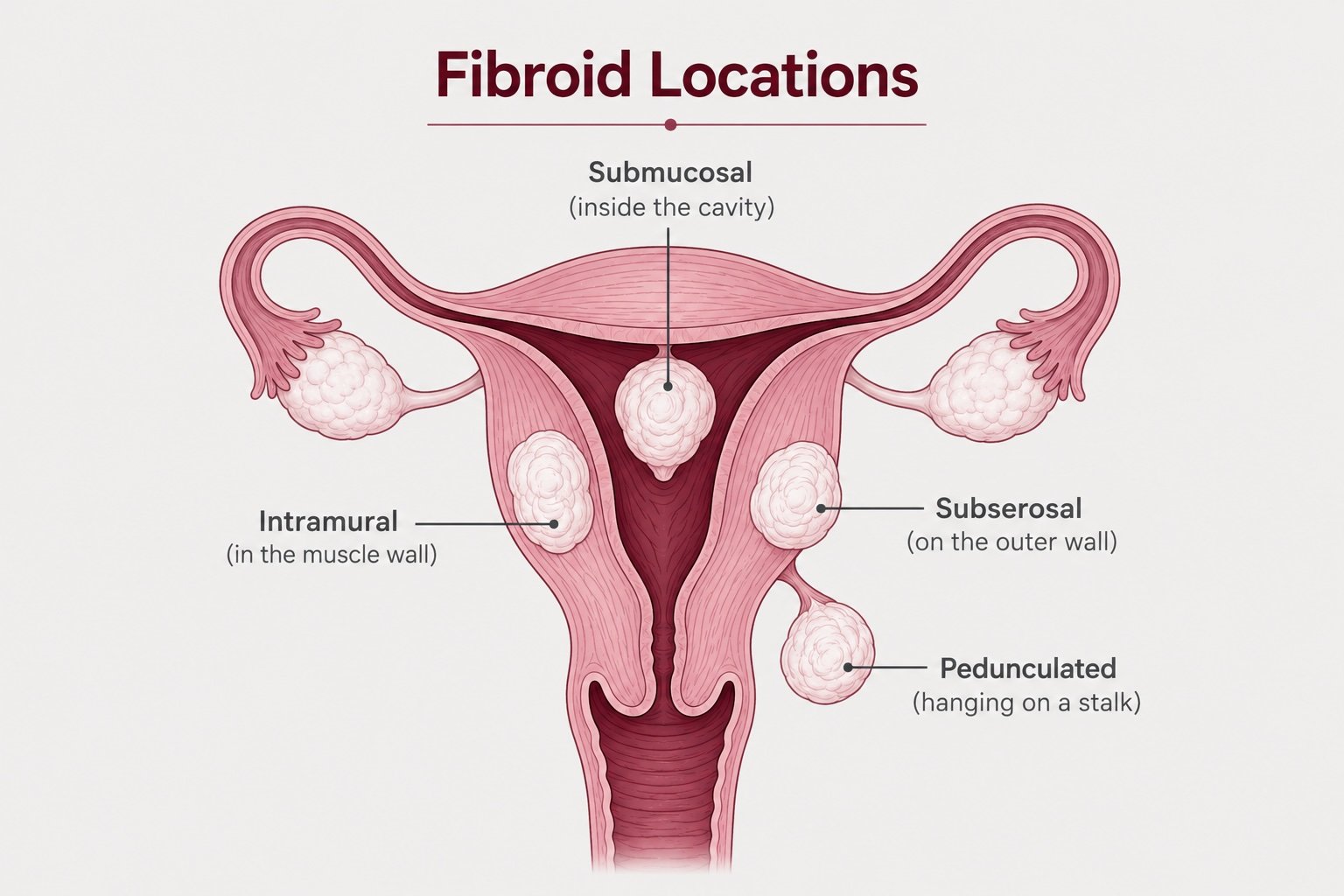
Submucosal fibroids grow into the uterine cavity itself. Even at small sizes, they cause heavy bleeding and fertility problems. Usually treated even when small.
Intramural fibroids grow within the muscular wall of the uterus. The most common type. As they grow above 4 to 5cm they can cause heavy bleeding and pelvic pressure.
Subserosal fibroids grow on the outside of the uterus. Can become very large before causing symptoms, producing pressure-related symptoms rather than bleeding.
Pedunculated fibroids hang on a stalk. They can twist on their stalk, which is a surgical emergency presenting as sudden severe pain.
Cervical fibroids are less common and can cause pain during sex, abnormal bleeding and difficulties during labour.
What size of fibroid affects fertility?
Fertility is affected by location more than size, but submucosal fibroids of any size and intramural fibroids over about 4cm have the strongest evidence for fertility impact. If you are trying to conceive and have been diagnosed with fibroids, a specialist consultation is worth arranging to determine whether the fibroid is likely to be contributing to fertility problems.
What size of fibroid is dangerous in pregnancy?
Fibroids generally tolerate pregnancy well, but larger fibroids (over 5 to 7cm) and those in certain locations carry increased risk. Possible complications include fibroid degeneration causing severe pain, malpresentation, preterm labour and increased risk of caesarean section. Pre-pregnancy treatment is usually preferred for women planning to conceive who have symptomatic fibroids.
How quickly do fibroids grow?
Fibroid growth varies enormously. Some stay the same size for decades. Others grow steadily by 1 to 2cm a year. Growth is influenced by oestrogen and progesterone levels, which is why fibroids tend to grow during the reproductive years and shrink after menopause.
A fibroid that grows by more than 50 per cent in a year, or any growth at all after menopause, deserves specialist assessment.
When should I see a specialist about my fibroid?
Book a consultation with a gynaecologist if any of the following apply:
- You have a fibroid that is causing symptoms (bleeding, pain, pressure)
- You have a fibroid over 5cm even without obvious symptoms
- Your fibroid has grown noticeably between scans
- You are trying to conceive and have any fibroid
- You have post-menopausal bleeding and a known fibroid
- You are unsure whether your fibroid needs treatment and want a second opinion
You can book a private fibroid consultation for £300 in our Chelsea clinic. There is also the option for a combined consultation and ultrasound scan for £475.
What are the treatment options for fibroids?
Monitoring: Suitable for small, asymptomatic fibroids. Usually annual ultrasound scans.
Medical management: Tranexamic acid for heavy bleeding, hormonal treatments (Mirena coil, combined pill, GnRH analogues), iron supplementation if anaemic.
Minimally invasive procedures: Hysteroscopic myomectomy (removes submucosal fibroids through the cervix), uterine fibroid embolisation (blocks blood supply, causing fibroids to shrink).
Surgical removal: Laparoscopic myomectomy (keyhole removal, preserving the uterus), open myomectomy (traditional surgery for larger or multiple fibroids), hysterectomy (removal of the uterus, considered when fertility is no longer a goal).
We have compared these approaches in detail in our guide to fibroid treatment options.
What happens if a large fibroid is left untreated?
Most large fibroids do not become medical emergencies, but untreated symptomatic fibroids can lead to chronic iron-deficiency anaemia, reduced quality of life, worsening pressure on bladder or bowel, continued fertility problems and, in rare cases, compression of the ureters causing kidney damage.
Once a fibroid is symptomatic and growing, it rarely resolves on its own except after menopause. Earlier intervention generally produces better outcomes.
Sources and further reading
- NHS – Fibroids
- NICE Guideline NG88 – Heavy menstrual bleeding: assessment and management
- Royal College of Obstetricians and Gynaecologists (RCOG) – Patient information on fibroids
Same-week appointments available. Our Fibroids Test & Monitoring appointment includes an initial consultation with a consultant gynaecologist, full pelvic examination and a pelvic ultrasound scan, from £475. Blood tests can be added at consultant discretion. Our all-inclusive Fibroids Package is also available for ongoing care and treatment.
Major private medical insurers accepted – please contact us to confirm your provider.
Frequently Asked Questions
Is a 4cm fibroid considered large?
A 4cm fibroid is in the small to medium range. Its impact depends heavily on location. A 4cm submucosal fibroid is more clinically significant than a 7cm subserosal one.
Is a 6cm fibroid dangerous?
A 6cm fibroid is usually in the range where treatment is commonly discussed, particularly if causing symptoms. Specialist assessment is advised.
Is a 10cm fibroid dangerous?
A 10cm fibroid is large and almost always treated. It carries higher risk of complications including pressure on adjacent organs and severe bleeding.
Can a small fibroid cause big problems?
Yes. A 1 to 3cm submucosal fibroid can cause flooding periods, severe iron deficiency and fertility problems. Size alone does not predict severity.
How fast do fibroids grow?
Most grow slowly, typically 1 to 2cm per year. Rapid growth, particularly after menopause, deserves investigation.
Do fibroids shrink after menopause?
Yes. Most shrink as oestrogen levels fall. New growth or bleeding after menopause is not normal and should be investigated.
Can I get pregnant with a 5cm fibroid?
It depends on location. A 5cm subserosal fibroid is usually compatible with pregnancy. A 5cm submucosal or intramural fibroid distorting the cavity may reduce fertility. Specialist advice is recommended.
Should I have surgery for a fibroid I have no symptoms from?
Generally no, unless the fibroid is very large, growing rapidly, affecting fertility or showing concerning features on imaging.
Can fibroids come back after treatment?
After myomectomy, there is a recurrence rate of around 10 to 25 per cent over 5 to 10 years. Hysterectomy permanently removes the possibility of new uterine fibroids.
By Kerry Archer
Medically reviewed by Mr Amer Raza, MBBS MRCOG, GMC 5205372 – 7 May 2026
Concerned About Your Fibroid? See a Specialist
If you have been told you have a fibroid and are unsure what it means or what to do next, a consultation with a specialist is the right starting point. Our gynaecology consultants can assess your fibroid, review your scan results and advise on next steps at our private Chelsea clinic. No GP referral needed. Private fibroid consultations £300, combined consultation with ultrasound scan £475.
