

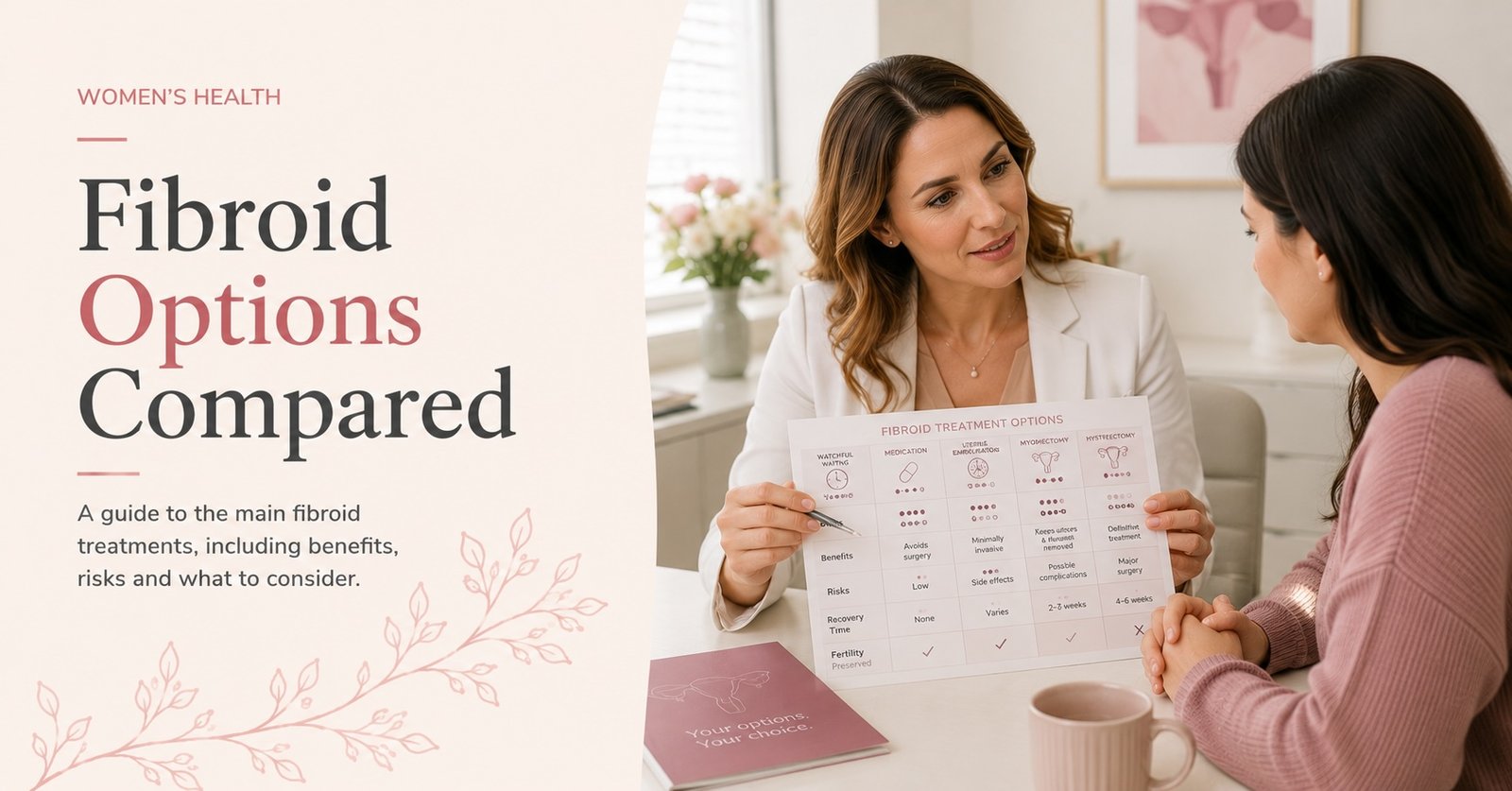
The three main treatments for fibroids are myomectomy (surgical removal of the fibroid), uterine fibroid embolisation (blocking the blood supply to shrink it) and hysterectomy (removal of the uterus). The best option depends on whether you want to preserve fertility, the size and location of the fibroid, your symptoms and your age. Myomectomy preserves the uterus and fertility, embolisation is less invasive but reduces fertility chances, and a hysterectomy is definitive but ends fertility entirely.
If you have been diagnosed with fibroids and told that treatment is needed, the next decision to be made is which one. This guide compares the main fibroid treatment options side by side, so you can see exactly how they differ before you speak to a specialist.
The 3 main options (myomectomy, uterine fibroid embolisation and hysterectomy) work in very different ways and have very different consequences for fertility, recovery and long-term outcomes and there are also less invasive options worth knowing about. Ovara Health provides private fibroid treatment in London from our clinic in Chelsea, with no GP referral needed.
When does a fibroid need treatment?
Treatment is usually advised when a fibroid is causing meaningful symptoms or carrying significant risk. The most common reasons to treat are:
- Heavy menstrual bleeding causing iron deficiency or anaemia
- Pelvic pressure causing bladder, bowel or back symptoms
- Pelvic pain that affects daily life
- Fertility difficulties or recurrent miscarriage
- Very large fibroids (typically over 10cm) regardless of symptoms
- Rapid growth or suspicious imaging features
Asymptomatic small fibroids are often monitored rather than treated. We have explained how the size of a fibroid and its location affect risk in our separate guide.
What is medical treatment for fibroids?
Medical treatment does not remove the fibroid – it manages symptoms, particularly heavy bleeding and is usually the first line for women whose fibroids are not severely symptomatic.
- Tranexamic acid taken during periods to reduce blood flow
- NSAIDs such as mefenamic acid for bleeding and pain
- Combined oral contraceptive pill to regulate periods
- Mirena coil which releases progesterone and reduces bleeding significantly
- GnRH analogues which temporarily stop oestrogen production and shrink fibroids
- Iron supplementation for associated anaemia
Medical treatment works best for women with mild to moderate symptoms, those approaching menopause or those who want to delay surgery but it doesn’t address pressure symptoms or fertility issues caused by fibroid bulk.
What is a myomectomy?
A myomectomy is surgical removal of the fibroid while leaving the uterus intact. It is the gold standard treatment for women who want to preserve their fertility.
Hysteroscopic myomectomy
Performed through the cervix using a thin telescope with no abdominal incision. It is used for submucosal fibroids inside the uterine cavity and is usually a day case procedure.
- Recovery: return to normal activities within 1 to 3 days
- Best for: submucosal fibroids up to about 4 to 5cm
Laparoscopic myomectomy
Keyhole surgery through small incisions in the abdomen. Faster recovery than open surgery with less scarring.
- Recovery: 2 to 4 weeks
- Best for: fibroids up to 8 to 10cm, ideally fewer than four fibroids
Open myomectomy
This involves traditional surgery through a horizontal abdominal incision.
- Recovery: 4 to 6 weeks
- Best for: large fibroids over 10cm, multiple fibroids, complex cases
A myomectomy preserves the uterus, fertility, menstruation and the option to have children.
New fibroids can develop and the recurrence rate is around 10-25% over a 5-10 year period.
Pregnancy after myomectomy may require caesarean section depending on the depth of the surgery.
What is uterine fibroid embolisation (UFE)?
UFE is a minimally invasive procedure done by an interventional radiologist whereby a thin catheter is passed through the wrist or groin into the arteries supplying the fibroid.
Tiny particles are injected to block the blood supply, causing the fibroid to shrink.
- Recovery: 1-2 weeks for return to most activities
- Fibroids typically shrink by 30 to 60 per cent over 3-6 months
- Symptom improvement in around 80 to 90 per cent of women
- No abdominal incision, no general anaesthetic required
Pregnancy is possible after UFE but it is not generally recommended as first-line treatment for women specifically wanting to conceive.
Around 10 to 20 per cent of women may need additional treatment within 5 years and the risk of premature ovarian failure is around 1-5%, particularly for those over 45.
What is a hysterectomy for fibroids?
Hysterectomy is removal of the uterus. It is the only treatment that guarantees fibroids will never return.
Types of hysterectomy:
- Total hysterectomy: removal of the uterus and cervix (most common)
- Subtotal hysterectomy: removal of the uterus only, cervix retained
- Hysterectomy with salpingo-oophorectomy: removal of uterus, cervix and ovaries
The ovaries are usually preserved unless there is a separate reason to remove them and preserving the ovaries means natural menopause is not triggered.
Approaches include vaginal, laparoscopic, robotic and open hysterectomy and leads to the end of fertility. Recovery ranges from 2 to 6 weeks depending on the approach taken.
How do the main treatments compare?
| Feature | Hysteroscopic myomectomy | Laparoscopic myomectomy | Open myomectomy | UFE | Hysterectomy |
|---|---|---|---|---|---|
| Removes uterus? | No | No | No | No | Yes |
| Preserves fertility? | Yes | Usually yes | Usually yes | Reduced | No |
| Suitable fibroid size | Up to 4-5cm | Up to 8-10cm | Any size | Up to about 10cm | Any size |
| Anaesthetic | General | General | General | Sedation | General |
| Hospital stay | Day case | 1-2 nights | 3-5 nights | Day case or 1 night | 1-3 nights |
| Recovery time | 1-3 days | 2-4 weeks | 4-6 weeks | 1-2 weeks | 2-6 weeks |
| Fibroid recurrence | Up to 25% | Up to 25% | Up to 25% | 10-20% may need further treatment | Cannot recur |
| Best for | Submucosal fibroids causing bleeding | Single or few fibroids preserving uterus | Large or multiple fibroids preserving uterus | Multiple fibroids when avoiding surgery | When fertility is no longer wanted |
Which fibroid treatment is right for fertility?
If your priority is preserving and ideally improving fertility, the order of preference is generally:
- Hysteroscopic myomectomy (for submucosal fibroids inside the cavity)
- Laparoscopic or open myomectomy (for larger or intramural fibroids)
- Medical management if symptoms are mild
- UFE is generally avoided as first-line if pregnancy is the goal
- Hysterectomy is not appropriate if fertility is wanted
How much does each fibroid treatment cost privately in the UK?
As a guide for private treatment in London:
- Hysteroscopic myomectomy: £3,000 to £5,500
- Laparoscopic myomectomy: £8,000 to £14,000
- Open myomectomy: £8,000 to £12,000
- UFE: £6,000 to £10,000
- Laparoscopic hysterectomy: £9,000 to £15,000
- Open hysterectomy: £8,000 to £12,000
Many private medical insurance policies cover fibroid treatment when symptoms meet defined thresholds.
Here at Ovara Health, we work with Bupa, AXA, Aviva, Vitality, WPA and CIGNA.
How do I decide which treatment is right for me?
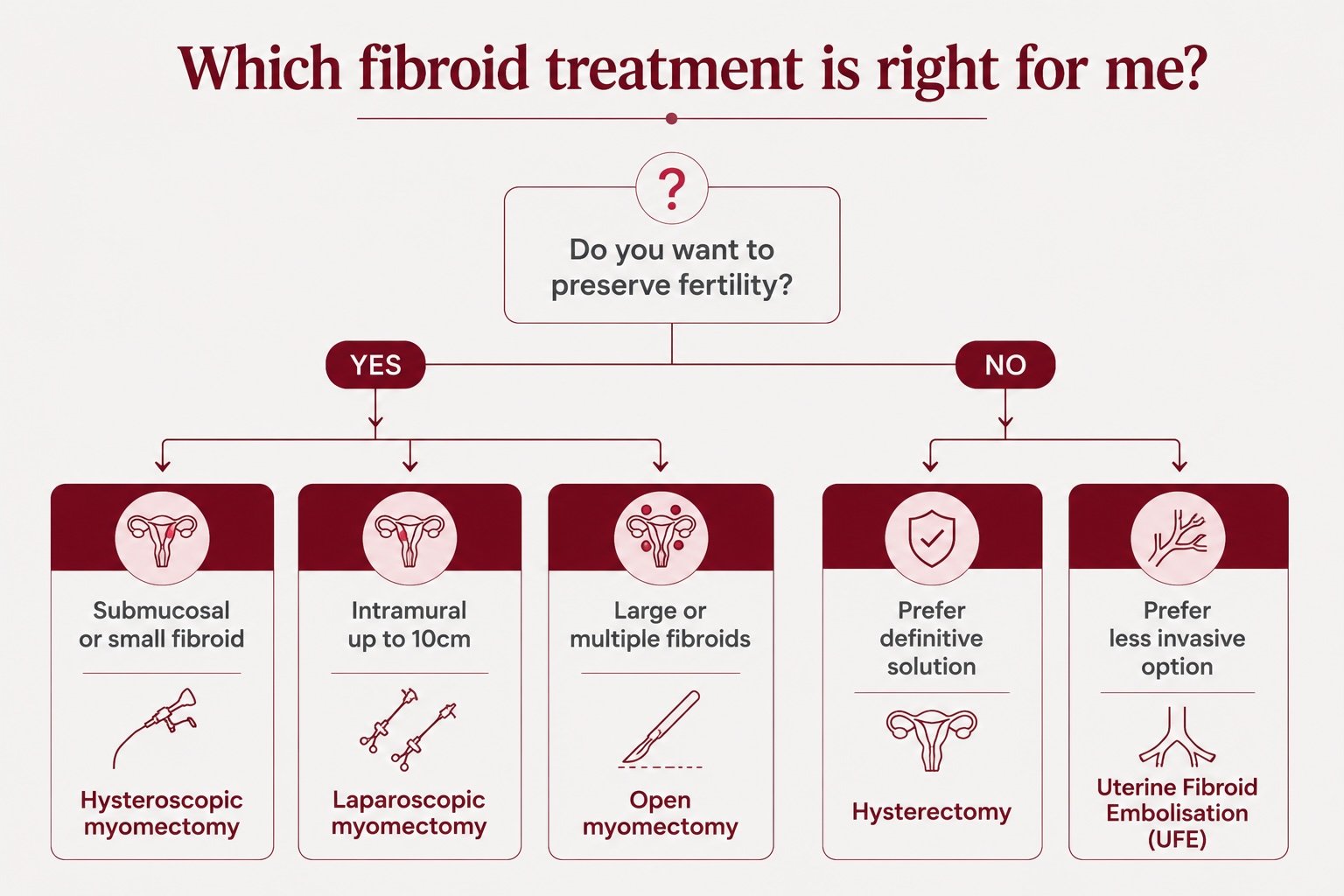
The decision should be made jointly with a specialist who has reviewed your full clinical picture. The key questions to work through are:
- Do you want to have children in the future?
- What size and where is the fibroid?
- What are your symptoms?
- What is your age?
- Do you have other gynaecological conditions?
- What is your tolerance for surgery and recovery?
- Are you covered by private insurance?
Our specialist team of gynaecologists at Ovara Health in Chelsea, London, performs hysteroscopic and laparoscopic myomectomy and works alongside interventional radiology colleagues for UFE. Consultations from £300.
Sources and further reading
- NHS – Treatment for fibroids
- NICE Guideline NG88 – Heavy menstrual bleeding: assessment and management
- Royal College of Obstetricians and Gynaecologists (RCOG) – Uterine fibroid embolisation patient information
- British Society for Gynaecological Endoscopy (BSGE) – Minimally invasive surgery guidance
Same-week appointments available. Our Fibroids Test & Monitoring appointment includes an initial consultation with a consultant gynaecologist, full pelvic examination and a pelvic ultrasound scan, from £475. Blood tests can be added at consultant discretion. Our all-inclusive Fibroids Package is also available for ongoing care and treatment.
Major private medical insurers accepted – please contact us to confirm your provider.
Frequently Asked Questions
What is the best fibroid treatment if I want to keep my uterus?
Myomectomy. The type depends on fibroid size and location.
What is the difference between a myomectomy and a hysterectomy?
Myomectomy removes the fibroid only, leaving the uterus. Hysterectomy removes the entire uterus.
Is UFE better than surgery for fibroids?
Neither is universally better. UFE is less invasive with shorter recovery but is less effective for large fibroids and has poorer fertility outcomes. Surgery is more definitive but more invasive.
Will I still have periods after a myomectomy?
Yes. Periods are usually lighter once heavy bleeding from the fibroid is resolved.
Can I get pregnant after a myomectomy?
Yes, in most cases. Pregnancy is usually advised after 6 to 12 months of healing.
Will my fibroids come back after treatment?
After myomectomy, around 10 to 25 per cent of women develop new fibroids over 5 to 10 years. After hysterectomy, fibroids cannot return.
Should I have a hysterectomy for fibroids?
A hysterectomy is usually considered when you have completed your family, when symptoms are severe, or when fibroids have returned after other treatment. It is the only option that guarantees fibroids cannot come back, but it is major surgery and it ends fertility permanently. If you may still want children, a myomectomy is the better route.
What is the recovery time after a myomectomy?
Recovery is 1 to 3 days after a hysteroscopic myomectomy, 2 to 4 weeks after a laparoscopic myomectomy and 4 to 6 weeks after an open myomectomy, with no heavy lifting for around 8 weeks after open surgery.
How long does fibroid surgery take?
A hysteroscopic myomectomy typically takes 30 to 60 minutes. A laparoscopic myomectomy takes 1.5 to 3 hours. An open myomectomy takes 1.5 to 4 hours depending on complexity.
Will I go through menopause after a hysterectomy for fibroids?
If your ovaries are preserved you will not enter menopause straight away, although natural menopause may arrive slightly earlier than it otherwise would. If your ovaries are removed, surgical menopause happens immediately.
Are these treatments available on the NHS?
Yes, although waiting times for non-urgent fibroid treatment can be 6 to 18 months in some areas.
Is fibroid treatment covered by private medical insurance?
Most major UK insurers cover fibroid treatment when symptoms meet their criteria. Always confirm with your insurer before booking.
By Kerry Archer
Medically reviewed by Mr Amer Raza, MBBS MRCOG, GMC 5205372 – 6 August 2026
Discuss Your Treatment Options With a Specialist
Choosing between myomectomy, embolisation and hysterectomy is a decision best made with a consultant who has reviewed your imaging and understands your fertility goals. We perform private hysteroscopic and laparoscopic myomectomy and offer personalised treatment consultations with no GP referral required. Consultations from £300.
