
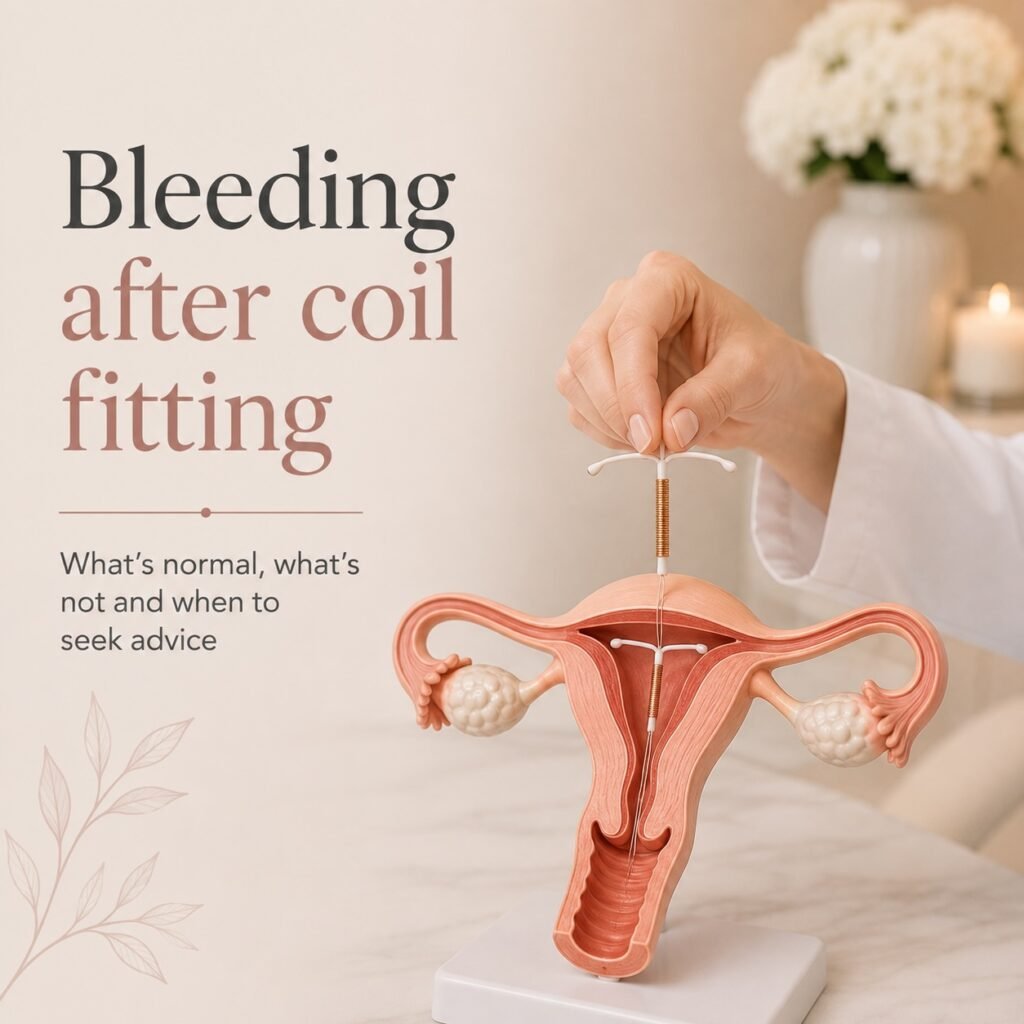
Bleeding After Coil Fitting: What Is Normal and When to Get Checked
Medically reviewed by Mr Amer Raza MBBS MRCOG, GMC 5205372 | Last reviewed: 18 August 2026
Bleeding after a coil fitting is normal and expected. Most women have some bleeding or spotting for a few days after the procedure, then irregular bleeding that settles over the following three to six months. The NHS advises that with both the copper coil and the hormonal coil, periods can be longer, heavier or more irregular during those first months, and that this usually improves on its own. What is not expected is bleeding that soaks through a pad an hour, comes with fever or foul smelling discharge, or is still heavy and unpredictable beyond six months. Those need assessment rather than patience.
Key Facts: Bleeding after coil fitting is normal for the first three to six months. The copper coil tends to make periods heavier, the hormonal coil tends to cause unpredictable spotting that later settles or stops. Get checked if bleeding is very heavy, smells offensive, comes with fever, or is still disruptive after six months.
“Almost every woman who comes back to me worried about bleeding after a coil fitting is having a completely normal settling-in period. The question I ask is not how much blood, it is what shape is it. Bleeding that is gradually becoming lighter and less frequent over weeks is doing exactly what it should. Bleeding that is getting heavier, or that started up again after settling, is the one I want to scan.”
Mr Amer Raza, Consultant Gynaecologist and Robotic Surgeon, Ovara Health
Is Bleeding After Coil Fitting Normal?
Yes. Bleeding after a coil fitting is one of the most common things women experience, and on its own it is not a sign that anything has gone wrong.
Two separate things are happening. The first is the fitting itself. Passing a device through the cervix irritates the cervical canal and the lining of the womb, and that causes light bleeding or spotting for a few days afterwards, often alongside period-type cramping. The second is your womb adjusting to having a device inside it, and that is a longer process measured in months rather than days.
The pattern is what tells you whether things are on track. Bleeding that is heaviest in the first few days, then becomes intermittent spotting, then gradually less frequent over the following months, is the normal course. It is rarely a smooth line. Most women have good weeks and bad weeks rather than steady improvement.
How Long Does Bleeding After Coil Fitting Last?
For most women the immediate bleeding after the procedure lasts a few days to about a week. The irregular bleeding and spotting that follows typically settles within three to six months.
The NHS gives three to six months as the expected settling period for both types of coil. That figure surprises people, because most women are told about the fitting appointment in detail and told very little about the months that follow. Knowing that six months is within normal range prevents a lot of unnecessary worry at week eight.
Beyond six months the advice changes. If irregular or heavy bleeding is still happening after six months, that is the point at which the NHS advises getting checked rather than waiting longer.
Does the Copper Coil or the Hormonal Coil Cause More Bleeding?
They cause different patterns, and knowing which coil you have makes your own experience much easier to interpret. This is the single most useful distinction on this page.
The practical difference is this. With the copper coil the bleeding is usually heavier but still recognisably a period. With the hormonal coil the bleeding is usually lighter but far less predictable, which many women find more annoying even though there is less blood. The hormonal coil is also the one that most often ends with no periods at all, which is a normal and safe outcome rather than something going wrong.
Why Does the Coil Cause Bleeding?
The lining of the womb has to adapt to the presence of a device, and that adaptation involves the small blood vessels in the lining becoming more fragile for a period of time. Fragile vessels shed small amounts of blood at unpredictable moments, which is what spotting is.
The copper coil works partly by creating a mild local inflammatory response inside the womb, which is what makes it effective without hormones. That same response tends to make the lining bleed more heavily during a period.
The hormonal coil releases a small amount of progestogen directly into the womb, which gradually thins the lining. While the lining is thinning it sheds erratically, which produces the irregular spotting. Once it has thinned properly there is very little lining left to shed, which is why periods often become very light or stop.
Worried about bleeding since your coil was fitted? You do not need a GP referral to be seen at Ovara Health. Call us on 0207 751 4488 or book a consultation for a coil check in Chelsea, including an ultrasound to confirm the position of the device.
Not ready to book? Send us an enquiry instead
Is Spotting After Coil Fitting Normal?
Yes, and it is the most common bleeding pattern of all after a coil fitting, particularly with the hormonal coil.
Spotting means light bleeding that does not need a pad or tampon, often brown or dark rather than red. Brown blood is simply older blood that has taken longer to leave the womb, and it is not a sign of infection on its own.
Spotting that appears at random points in the month, lasts a day or two, stops, then returns a week later is typical during the settling period. It is irritating rather than dangerous. Most women find it becomes noticeably less frequent by around month four.
Why Do I Have Blood Clots After Coil Fitting?
Small clots during a period are normal and are more common with the copper coil, because heavier flow means blood pools for longer before leaving the womb and has time to clot.
Clots up to about the size of a ten pence piece, appearing on the heaviest day or two of a period, are generally not a concern. What warrants assessment is clots larger than a fifty pence piece, clots appearing repeatedly across several days, or clots alongside flow heavy enough to soak through protection every hour.
When Is Bleeding After Coil Fitting a Concern?
Most bleeding after a coil fitting is normal. These are the patterns that are not, and each has a specific reason behind it.
- Very heavy bleeding. Soaking through a pad or tampon every hour for several hours, or feeling dizzy, breathless or unusually tired. The NHS advises seeking urgent care for very heavy vaginal bleeding
- Bleeding with fever or offensive smelling discharge. This combination suggests infection and needs same week assessment, not waiting
- Bleeding with severe or one-sided pelvic pain. Needs assessment to rule out the coil having moved or perforated
- Bleeding after sex, repeatedly. Worth checking the cervix rather than assuming it is the coil
- Bleeding that had settled and then restarted. A new change after a stable period is more significant than continuous bleeding that is slowly improving
- Still heavy or irregular beyond six months. The NHS advises a check-up at this point
- You cannot feel the threads, or you feel the hard stem of the device. This suggests the coil has moved and you are not protected from pregnancy
Could the Coil Have Moved or Fallen Out?
It is uncommon but it happens, most often in the first three months and most often during a period, when cramping can push the device downwards.
The signs are a change in the pattern of bleeding after things had settled, new or worsening cramping, threads that feel longer or shorter than they did, being unable to feel the threads at all, or feeling something firm at the cervix. Your partner noticing the threads during sex when they never did before is also worth acting on.
An ultrasound settles this question quickly and definitively. It shows exactly where the device is sitting and whether it is correctly positioned. If you cannot feel your threads, use condoms until you have been checked, because a displaced coil may not be preventing pregnancy.
Could Bleeding Mean an Infection?
There is a small increased risk of pelvic infection in the first few weeks after a coil is fitted, and bleeding can be one part of how it presents. Infection rarely shows up as bleeding alone.
The pattern that matters is bleeding together with other signs: a temperature, discharge that smells offensive or has changed colour, pelvic pain that is worsening rather than easing, or pain deep inside during sex. Infection treated early is straightforward. Infection left for weeks can affect the fallopian tubes and future fertility, which is why the advice is to be seen promptly rather than to monitor at home.
What Can Help Settle the Bleeding?
There is no way to shorten the adjustment period itself, but several things help you manage it.
Anti-inflammatory painkillers such as ibuprofen, taken as directed and if suitable for you, can reduce both cramping and the volume of bleeding during a period. Tracking your bleeding on a calendar or app is genuinely useful, because it turns a vague sense that things are bad into a pattern you and your doctor can actually read, and it usually shows improvement that is hard to perceive day to day.
If bleeding is heavy enough to be affecting your iron levels, a blood test is worth doing. Persistent heavy bleeding is a common and easily missed cause of low iron, and treating that often makes women feel substantially better even while the coil settles.
For related reading, see our guides to pain after coil fitting, pain during coil fitting and coil advice and aftercare.
Seek urgent medical help by calling 999 or going to A&E if you are soaking through a pad every hour for several hours, feel faint, dizzy or breathless, have severe abdominal pain, or have a high temperature with offensive smelling discharge. These need same day assessment.
What Happens at a Coil Check at Ovara Health?
You do not need a GP referral to be seen. A coil check at our Chelsea clinic usually takes one appointment and answers the two questions women actually have: is the coil in the right place, and is this bleeding normal.
You are seen by a consultant gynaecologist rather than a nurse or trainee. The appointment covers a discussion of your bleeding pattern since fitting, an examination to check the threads and the cervix, and an ultrasound to confirm the exact position of the device. Where bleeding has been heavy we can also arrange blood tests to check your iron levels at the same visit.
If everything is normal you leave knowing that, with a clear idea of what to expect over the coming months. If the coil has moved, or there is an infection, or something else is causing the bleeding, we deal with it there rather than sending you away to wait.
Frequently Asked Questions About Bleeding After Coil Fitting
How long does bleeding last after coil fitting?
Immediate bleeding after the procedure usually lasts a few days to a week. Irregular bleeding and spotting after that typically settles within three to six months for both the copper and the hormonal coil. If irregular or heavy bleeding is still happening beyond six months, the NHS advises getting checked rather than waiting longer.
Is it normal to bleed for weeks after a coil fitting?
Yes, prolonged irregular bleeding or spotting for several weeks is common in the first few months, particularly with the hormonal coil. It should be gradually becoming lighter and less frequent. Bleeding that is getting heavier over time, or that restarted after settling, should be assessed.
How much bleeding is too much after coil fitting?
Bleeding heavy enough to soak through a pad or tampon every hour for several hours in a row is too much and needs urgent assessment. Other warning signs are passing clots larger than a fifty pence piece repeatedly, or feeling dizzy, breathless or unusually tired, which can indicate blood loss affecting your iron levels.
Is brown discharge after coil fitting normal?
Yes. Brown discharge is simply older blood that has taken longer to leave the womb, and it is very common during the settling period. It is not a sign of infection on its own. Brown discharge that smells offensive, or comes with fever or worsening pain, does need checking.
Can the coil cause bleeding after sex?
Occasional light bleeding after sex can happen while the cervix is still settling in the first few weeks. Repeated bleeding after sex should be assessed rather than assumed to be the coil, because it can indicate a cervical cause that is worth examining directly.
Does the hormonal coil stop periods completely?
It often does. The hormonal coil thins the lining of the womb, and once it is thin there is very little to shed. Many women find periods become very light or stop altogether after the first six to twelve months. This is a normal and safe outcome, not a sign anything is wrong.
Why is my period heavier since having the copper coil fitted?
The copper coil works partly by creating a mild inflammatory response inside the womb, and that same response tends to make the lining bleed more heavily during a period. The NHS notes periods can be heavier, longer or more painful in the first three to six months, usually improving after that, though they often remain somewhat heavier than before.
How do I know if my coil has moved?
Signs include a change in your bleeding pattern after things had settled, new or worsening cramping, threads that feel longer or shorter than usual, being unable to feel the threads at all, or feeling the hard stem of the device at the cervix. An ultrasound confirms the position quickly. Use condoms until you have been checked.
Can I use tampons while bleeding after a coil fitting?
Most clinicians advise using pads rather than tampons or menstrual cups for the first few days to reduce the risk of infection while the cervix settles. After that, tampons and cups are generally fine. If you use a menstrual cup, break the seal carefully before removing it, as suction can dislodge the threads.
Should I have my coil removed if the bleeding is bad?
Not usually as a first step, because most bleeding settles within three to six months and removing the coil early means losing the benefit before it has had a chance to work. If bleeding is still disruptive beyond six months, or is affecting your iron levels or quality of life, that is a reasonable point to discuss removal or a different method.
Can bleeding after coil fitting mean I am pregnant?
It is very unlikely, as both coils are more than 99% effective. However, pregnancy is not impossible, particularly if the coil has moved. If you have bleeding along with severe one-sided pain, or you cannot feel the threads, take a pregnancy test and get assessed promptly, because a pregnancy with a coil in place needs to be checked for ectopic pregnancy.
Does bleeding after coil fitting mean it is not working?
No. Bleeding and spotting are part of how the womb adjusts and do not indicate that contraceptive protection has failed. Both types of coil remain highly effective throughout the settling period, provided the device is correctly positioned. The one thing that does affect protection is the coil moving, which is why threads you cannot feel are worth checking.
Is it normal to bleed during the coil fitting itself?
Yes. Light bleeding during and immediately after the procedure is expected, caused by passing the device through the cervix. It is usually light and settles within a few days. Heavy bleeding at the time of fitting is not typical and should be raised with whoever fitted the device.
When should I see a doctor about bleeding after coil fitting?
See a doctor if bleeding is very heavy, comes with fever or offensive smelling discharge, comes with severe or one-sided pain, restarted after having settled, or is still heavy and irregular beyond six months. Also get checked if you cannot feel the threads or can feel the hard stem of the device.
Sources
- NHS. Side effects of an IUD (intrauterine device) or copper coil. nhs.uk
- NHS. Side effects and risks of an IUS (intrauterine system) or hormonal coil. nhs.uk
- NHS. How contraception affects periods. nhs.uk
- Faculty of Sexual and Reproductive Healthcare. Intrauterine contraception guidance. fsrh.org
This article is for general information and does not replace individual medical advice. If you are concerned about bleeding after a coil fitting, please speak to a doctor. If you need urgent help, contact your GP, call 111, or call 999 in an emergency.
Speak to a Consultant Gynaecologist in Chelsea
If bleeding since your coil was fitted is worrying you, a single appointment with a scan can confirm the coil is correctly positioned and tell you whether what you are experiencing is normal. No GP referral is needed.