
Colposcopy and Biopsy: What to Expect, Results and What Happens Next
Medically reviewed by Mr Amer Raza MBBS MRCOG, Consultant Gynaecologist, Ovara Health (GMC 5205372) | Last reviewed: 17 July 2026
Key Facts: A colposcopy is a close examination of the cervix, usually after an abnormal smear test result. A biopsy, the removal of a tiny tissue sample, is taken during the same appointment only if an abnormal area is seen. The examination takes 10 to 20 minutes in an outpatient setting with no general anaesthetic. Most women describe the discomfort as similar to period cramps, and results guide the next step in your care.
Being referred for a colposcopy after an abnormal smear test result is understandably worrying. Most women are not sure what the procedure involves, how painful it is or what their results will mean. This guide explains everything: what happens during a colposcopy and biopsy, what the results can tell you and what happens next.
Quick Answer: A colposcopy is a magnified look at the cervix to find out whether abnormal cells need attention. It is an investigation, not a treatment. A biopsy is only taken if the specialist sees an area that needs closer analysis, and an abnormal result does not mean cancer. The large majority of findings are low-grade changes that either resolve on their own or are treated very straightforwardly.
What is a colposcopy and why is it done?
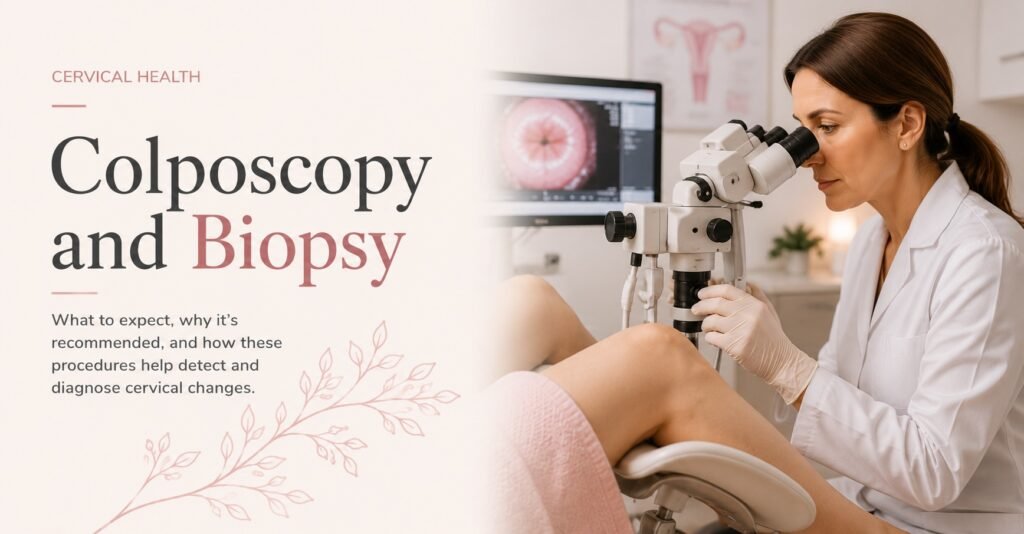
A colposcopy is a detailed examination of the cervix using a colposcope: a device similar to a pair of binoculars on a stand that sits outside the body and magnifies the cervix to give the doctor a clear view. It does not enter the body.
The procedure is most commonly arranged after an abnormal smear test result, specifically when cervical screening has detected HPV alongside cell changes, or when the changes seen in the laboratory are significant enough to warrant a closer look.
Common reasons for referral include:
- An abnormal smear result showing high-grade dyskaryosis (moderate or severe cell changes)
- A low-grade result combined with a high-risk HPV type
- Persistent low-grade changes over successive smear tests
- An inconclusive smear result that needs further assessment
- Abnormal bleeding between periods, after sex or after the menopause
- An unusual appearance of the cervix noticed during a routine examination
A colposcopy tells the doctor whether and where abnormal cells are present on the cervix, and how significant those changes are. It does not treat the cells, it investigates them. Treatment is a separate step if it is needed at all.
Is it normal to have a biopsy during a colposcopy?
Yes, when an abnormal area is seen. A biopsy means a small sample of tissue is taken from the cervix for laboratory analysis, and it is only taken if the colposcopist sees an area that looks abnormal under the colposcope. Not every colposcopy results in a biopsy.
During the examination, the doctor applies a weak solution of acetic acid (similar to vinegar) to the cervix. Abnormal cells temporarily turn white under this solution, which is called an acetowhite reaction. If a white area appears, a biopsy is taken from that exact spot so the laboratory can examine the cells precisely.
The biopsy itself is quick. A small instrument removes a tiny piece of tissue, usually 2 to 3 millimetres wide, and it takes only a few seconds. You may feel a brief sharp sensation or cramp when the sample is taken.
What happens step by step during a colposcopy and biopsy?
Before the appointment
- You do not need to fast
- Taking simple painkillers (paracetamol 1g and ibuprofen 400mg) about an hour before your appointment significantly reduces discomfort
- Wear comfortable, loose clothing
- Arrange for someone to accompany you if you are anxious or prefer not to travel alone afterwards
- Avoid booking during your heaviest period days. Light bleeding is fine, but heavy flow can make the cervix harder to assess
At the clinic
- Consultation. The doctor explains the procedure, confirms your smear result and medical history, then answers any questions before you consent to proceed.
- Undressing. You remove clothing from the waist down and lie on an examination couch with a sheet or drape covering you.
- Speculum insertion. A speculum is placed to hold the vaginal walls apart and allow a clear view of the cervix, the same as a smear test.
- Acetic acid solution. A weak acetic acid solution is applied to the cervix. You will not feel this, but it causes any abnormal cells to temporarily appear white under the colposcope.
- Examination. The doctor examines the cervix carefully through the colposcope. You may be able to see the images on a screen if you wish.
- Biopsy (if needed). If an abnormal area is seen, a small biopsy is taken. This takes seconds. You will feel a brief cramp or sharp pinch.
- End of procedure. The speculum is removed. Mild cramping is normal in the minutes that follow.
- Recovery. Most women feel well enough to leave within 15 to 20 minutes. Light spotting from the biopsy site is expected.
The whole appointment usually takes 30 to 45 minutes, including the consultation and recovery time. The examination and biopsy together take around 10 to 20 minutes.
How painful is a biopsy during colposcopy?
Most women find a colposcopy uncomfortable rather than severely painful. The biopsy adds a brief additional sensation, most commonly described as a sharp cramp or pinch lasting just a few seconds.
What to expect at each stage:
- Speculum insertion: similar to a smear test, uncomfortable but not typically painful
- Acetic acid application: no sensation at all
- Colposcope examination: no sensation, it does not touch the body
- Biopsy: a brief sharp cramp lasting 1 to 3 seconds, sometimes followed by a dull ache for a few minutes
Pain levels vary depending on your individual anatomy, anxiety levels, the position of the cervix and whether you have had vaginal births before. Taking ibuprofen and paracetamol beforehand makes a meaningful difference. If you experience strong pain during the procedure, tell the doctor immediately. The procedure can be paused, local anaesthetic applied or the examination adapted.
Feeling anxious about your colposcopy? You do not need a GP referral to be seen at Ovara Health. Call us on 0207 751 4488 or get in touch to discuss the procedure, ask questions and plan your care with Mr Amer Raza, Consultant Gynaecologist, at our Chelsea clinic.
Book a private colposcopy in Chelsea →
What do colposcopy biopsy results mean?
Biopsy results are usually available within 4 to 6 weeks on the NHS, and often within 2 to 4 weeks privately. The laboratory examines the tissue sample and reports on the degree of cellular abnormality found. CIN stands for cervical intraepithelial neoplasia and describes how far through the layers of the cervical lining the abnormal cells extend. CIN 1, 2 and 3 are all pre-cancerous changes, not cancer.
The large majority of colposcopy results show CIN 1 or CIN 2. Even CIN 3 is a pre-cancerous change that is treated highly effectively before cancer has a chance to develop. This is precisely why the cervical screening programme exists.
How long does colposcopy and biopsy recovery take?
Recovery is generally quick. Most women feel well enough to return to normal activities the same day or the following day.
In the hours after the appointment:
- Mild cramping similar to period pain, usually settling within 1 to 4 hours
- Light spotting or pinkish discharge from the biopsy site
- Some women feel tired or emotionally drained from the experience, which is completely normal
In the days that follow:
- Light bleeding or spotting for up to 1 to 2 weeks
- A dark discharge if Monsel’s solution (an iron-containing paste used to reduce bleeding) was applied during the procedure
- No significant pain in most cases
Most women return to work the same day or the next, and there are no restrictions on eating, drinking or light exercise.
What aftercare should you follow after a colposcopy biopsy?
- Avoid tampons for at least 4 weeks. Use sanitary pads only
- Avoid sex for at least 4 weeks, or until any bleeding has stopped completely
- Avoid swimming and baths for 4 weeks (showers are fine)
- Avoid strenuous exercise for 48 hours
These precautions reduce the risk of infection and allow the small wound at the biopsy site to heal.
Is bright red bleeding after a colposcopy biopsy normal?
Some fresh red spotting after a biopsy is normal and will ease as the site heals. Contact your clinic or GP promptly if you experience heavy red bleeding (soaking a pad in less than an hour), bright red bleeding that does not ease within a few days, fever or chills alongside any bleeding, or foul-smelling discharge.
Seek emergency care if you have heavy bleeding with dizziness or fainting, severe constant and worsening abdominal pain, or signs of serious infection such as high fever, vomiting or confusion. Call 999 or go to your nearest A&E.
What about pain and your first period after the biopsy?
Mild lower abdominal cramping for a few hours after the procedure is completely normal. It feels similar to period pain and responds well to paracetamol or ibuprofen. Pain that is severe, worsening after the first 24 hours, accompanied by fever or not responding to standard painkillers should always be assessed.
Your first period after a colposcopy and biopsy may arrive slightly earlier or later than usual and may be a little heavier than normal. This is common and settles by the next cycle in most cases. If your period is significantly heavier than usual, lasts longer than 10 days or comes with unusual pain, speak to your GP or contact the clinic.
What happens next after your colposcopy biopsy results?
If results are normal: you return to routine cervical screening, at the interval your doctor advises.
If CIN 1 is found: low-grade changes are often monitored rather than treated immediately, because many resolve without intervention. You will usually have a follow-up colposcopy or smear in 6 to 12 months.
If CIN 2 or CIN 3 is found: treatment to remove the abnormal cells is usually recommended. The most common treatment is LLETZ (large loop excision of the transformation zone), which removes the abnormal area using a thin wire loop. It is a quick outpatient procedure, often done under local anaesthetic.
If CGIN is found: glandular cell changes require specialist assessment and often treatment, as the abnormal cells may be higher up in the cervical canal.
If cancer is detected: this is uncommon, but if it occurs you will be referred urgently to a specialist cancer team. Finding cervical cancer at the colposcopy stage means it has been caught early and treatment options are significantly better.
Should you have a colposcopy privately or on the NHS?
NHS colposcopy is excellent and free at the point of use. A private colposcopy is worth considering if you are anxious and want to be seen quickly, you want to choose your consultant or you want more time to discuss your results and next steps.
At Ovara Health in Chelsea, colposcopy and cervical biopsy are carried out by Mr Amer Raza, MBBS MRCOG, Consultant Gynaecologist, with direct access and no GP referral needed.
Frequently asked questions
What is the difference between a colposcopy and a biopsy?
A colposcopy is an examination of the cervix using a magnifying device (the colposcope) to look for abnormal cells. A biopsy is the removal of a small tissue sample during that examination. They are two separate steps that often happen in the same appointment. The colposcopy shows where abnormal areas are; the biopsy confirms exactly what those cells look like under the microscope.
Does everyone having a colposcopy need a biopsy?
No. A biopsy is only taken if the colposcopist sees an area that appears abnormal during the examination. Some women have a colposcopy where the cervix looks entirely normal and no biopsy is needed.
How long does a colposcopy and biopsy take?
The examination and biopsy together usually take 10 to 20 minutes. Including the consultation beforehand and a short recovery period, most appointments last 30 to 45 minutes in total.
How painful is a colposcopy biopsy?
Most women describe the biopsy as a brief sharp cramp or pinch lasting 1 to 3 seconds. The overall procedure is uncomfortable rather than severely painful for most people. Taking ibuprofen and paracetamol an hour before your appointment helps significantly.
How long do colposcopy biopsy results take?
Results are usually ready within 4 to 6 weeks on the NHS. In a private setting the turnaround is often 2 to 4 weeks. Your doctor will contact you to discuss the findings and next steps.
What does CIN mean in colposcopy results?
CIN stands for cervical intraepithelial neoplasia. It describes pre-cancerous cell changes in the lining of the cervix. CIN 1 is mild, CIN 2 is moderate and CIN 3 is severe. None of these are cancer. They are changes that need either monitoring or treatment to prevent cancer developing.
Can I go to work after a colposcopy and biopsy?
Most women can return to work the same day or the following day. If your work involves heavy physical activity, taking 24 to 48 hours is sensible. Desk-based or light work is usually fine the same day.
How long should I bleed after a colposcopy biopsy?
Light spotting or discharge for 1 to 2 weeks after the biopsy is normal. If you experience heavy bright red bleeding, especially if it soaks through pads within an hour, contact your clinic or GP.
Can I have sex after a colposcopy and biopsy?
No. Wait at least 4 weeks, or until all bleeding and discharge has stopped, before having sex. This reduces the risk of infection at the biopsy site.
What happens if my colposcopy biopsy results are abnormal?
An abnormal result means the cells in the biopsy sample showed changes. The result will specify the grade (CIN 1, 2 or 3). Your doctor will explain the findings and recommend the appropriate next step, which may be monitoring or treatment. An abnormal colposcopy result is not a cancer diagnosis.
Do I need a GP referral for a private colposcopy?
No. At Ovara Health in Chelsea, you can book a private colposcopy directly without a GP referral.
Can a colposcopy detect cervical cancer?
A colposcopy can identify areas of abnormal cells that may be pre-cancerous. If the biopsy result shows cancerous changes, you will be referred urgently to a specialist cancer team. Finding these changes at the colposcopy stage means they have been caught at the earliest possible point, when treatment is most effective.
What is the difference between colposcopy and a smear test?
A smear test (cervical screening) takes a small brush sample from the cervix to check for HPV and cell changes under a microscope. A colposcopy is a follow-up procedure that gives a direct magnified view of the cervix when those results are abnormal. A smear test is a screening tool; a colposcopy is a diagnostic examination.
How much does a private colposcopy cost at Ovara Health?
A colposcopy, with or without biopsy, is £856, and a new consultation is £300. Laboratory analysis of any biopsy sample is charged separately. Current pricing is confirmed when you book.
Sources and further reading
- NHS: Colposcopy
- Jo’s Cervical Cancer Trust: Colposcopy
- British Society for Colposcopy and Cervical Pathology
- NICE Guideline NG12: Suspected Cancer Recognition and Referral
This article is for general information only and does not constitute medical advice. It is not a substitute for assessment by a qualified clinician.
Private colposcopy and biopsy in Chelsea, London
At Ovara Health you can book a colposcopy without a GP referral. Appointments are usually available within 1 to 2 weeks, results are discussed with you rather than sent by letter, and most major insurers are accepted alongside clear self-pay pricing.
Book Online
Call Us: 0207 751 4488
Request a Callback
Written by Kerry Archer. Medically reviewed by Mr Amer Raza MBBS MRCOG, Consultant Gynaecologist (GMC 5205372). Last reviewed: 17 July 2026.